Monday, January 9, 2023

Trends for Indian Retail in 2023

 2022 was a return to near normal for Indian retail. That leads to the question as to what 2023 holds for this sector. Trends that would dominate this sector has been detailed in this article published in The Hindu Business Line. Clicnk on this link to read the full article - Trends that will shape Indian retail this year - The Hindu BusinessLine


Thursday, April 16, 2020

Indian Retail after the Lock down and Corona Virus scare in 2020

In the mid 1990s when Modern Trade started off in India, everyone started saying that Kirana or small stand alone stores are doomed. After a few years later when online retail started, physical stores were expected to be badly hit. Although there has been some impact with regard to a few categories by online retail on physical stores, it is nowhere as widespread as prophesied. Kirana stores have always marched on stoically. 

Fast forward to 2020 and the Covid-19 scare which has led to lock downs in most countries including India.

Interestingly, the small stores or Kiranas are managing quite well and many shoppers are dependent on these stores for their essentials. Many physical stores are catering to the shopper’s essential purchases. In spite of the lock down situation and home quarantine, online which had a good opportunity especially in the food space is grappling with delivery and stock challenges.

How will shopper behavior be after the Lock down? Which format will be preferred by shoppers? What might happen to the consumption patterns? Will there be a dramatic change after the Corona Virus scare goes away or at least reduces?

Most importantly, what will happen to Indian Retail and its various segments?

All these points have been detailed in this article published in Business Line’s BLoC. Click on this link to read the article and share your comments - What will shopping look like after Covid-19?

Thursday, December 5, 2019

Convenience store format in India

Kirana stores or the small neighborhood shop has always been predicted to close down in the face of competition. In the mid 90s when the Foodworld Supermarket chain started, everyone expected these small shops to shut down in that area. Later on with the arrival of several chains and then online retail, this doomsday prediction for these small shops has always been around.

Interestingly, till date these small Kirana shops have not only stuck around but have also managed to keep up with the shopper expectations. They have implemented various value additions like cramming in a few shelves to create a self service shopping experience, extended hours of operation, better service, etc.

Coupled with their penetration in any locality, they are truly the Indian version of convenience stores.

However, this might be challenged, soon. Already a few convenience store chains have started and recently a global retail chain has announced their entry into India.

How will the kirana stores compete in the face of such direct competition, Will the global chain be able to have a quick and easy entry? Will this finally lead to the Kirana stores to be affected? – Many more such questions have been addressed in my two articles in the “Inside Retail” column of the Business Line on Campus.

The links to these two articles are –

- https://bloncampus.thehindubusinessline.com/columns/inside-retail/can-indias-convenience-stores-stand-up-to-competition-from-abroad/article29856810.ece

- https://bloncampus.thehindubusinessline.com/columns/inside-retail/challenges-for-7-eleven-store-chain-in-india/article29983936.ece

Please share your views and comments about this.

Saturday, November 30, 2019

Inside Retail; The great Indian MRP trick

One of my pet topics! 

During a session where I was explaining about MRP being irrelevant in the current market scenario, an interesting question/ counter point came up.

This point was - “MRP printed on a product gives the consumer some assurance about the price. If there was no MRP, what is the guarantee that retailers would not fleece the customers?”

The article “The great Indian MRP trick” answers this question as also reiterates that MRP as a concept is neither applicable universally nor is it being insisted upon and most definitely is enforced in very rare instances.

Please share your views and comments about this.

Wednesday, November 27, 2019

Inside Retail; Long way to go for omni channel retail

I have been remiss in sharing thoughts and insights about Retail in the blog due to lot of travelling and extensive engagements. Let me resume by sharing some articles I had written for my new column in the Business Line on Campus (BLoC) titled “Inside Retail” .

A full page advertisement by a retailer claiming to be an omni channel operator piqued my curiosity. Omni channel is easier to claim than do and this article explains the reasons for the same.

The full can be read by clicking on this link - “Long way to go for seamless omni channel shopping experience”. Please do share your views and feedback in the comments section.

Friday, March 29, 2019

Believing in what you sell is one of the most critical aspect in retail.

David Ogilvy, one of the gurus of advertising is credited with this quote; “I never assign a product to a writer unless I know that he is personally interested in it. Every time I have written a bad campaign, it has been because the product did not interest me.”

Decades later this maxim holds true for not only advertising but actually about almost everything we do in life. If we truly believe in something, we give it our best and the outcome is invariably a positive one.

This reality becomes critical in retail as the shopper is driven and motivated by the trust he or she reposes in the store. In reality, it is not even in the store but in the staff and their service.

It is no wonder that the staff are referred to as the “Face of the Retailer”.

In spite of this, the majority of training initiatives are focused on customer service, smiling and wishing the customer, etc. Very rarely have I come across a retailer who takes the trouble to sell their merchandise to their own staff and make them to truly believe in what they are being asked o sell.

That was the crux of the issue that was mentioned to me by a young retail manager and which led to this “Business Line” article; Do you believe in what you sell?

Apart from the interesting anecdote about my interaction with this your retail professional, the article also captures an essential milestone in the journey of modern trade in India, especially that of food/ supermarket formats.

Tuesday, March 12, 2019

Ten years and counting!

March 2009, when I decided to start my blog “An Indian and A Retailer”, has definitely become a defining moment in my life journey. Ten years and 1,00,000 plus views later, the blog still continues to attract regular readers who often use its contents as a reference with regard to Indian Retail.

The blog started off as a simple repository of my experiences and learning in the Indian Retail space. It went on to become the foundation stone of my journey as an author. This blog led to my first book “The INDIAN reTALEs”. That was followed by “Out Of Syllabus”, “BREAK FREE” and the latest one, “The Ultimate Guide to SMART SHOPPING”. This has been in addition to the various articles I have written for leading business publications. 

All these must total up to approximately four lakh plus words over the years.

A BIG THANK YOU to all my readers who found my writing to be of interest and use. Many of them have given private feedback as also written public reviews. 

Two anecdotes are worth sharing as part of this milestone.

The first is about the actual start of my journey in writing. In 2000 after I had returned from the UK after completing the Chevening Scholarship, Business Line invited me to write an article. This was to be about my stint at ASDA and was titled “Making an elephant dance”. The article detailed the interesting practices that were followed at ASDA to keep their large number of employees engaged and nimble footed to remain customer centric. The blog, in a manner of speaking continued from where this article had led me in the journey of being an author.

The second one is about the name for my blog. It was a challenge as I was conflicted by various ideas and options. The final decision was influenced by using the two identities that I am most proud of and has defined me as a person. 

An Indian; growing up in the pre-liberalization period and witnessing the contribution that an individual can make as an ordinary citizen of India has always been motivating to me. Post liberalization, this has only been reinforced. In spite of several options to pursue a career abroad, the appeal of being an Indian contributing to the country’s growth in whatever small way possible has held greater appeal for me.

A Retailer; is how I think and operate. The experiences from this sector have defined my outlook and continue to do so. I am immensely grateful that God led me into this sector and am thankful to all my mentors who have taught me about the various facets about retail.

One of the topics I have written extensively about is that the retail sector in India should be granted industry status. This would not only spur this sector to faster and better growth but also contribute significantly to the Indian economy. My fond wish and hope as “An Indian and A Retailer”, is that this happens soon. I hope that the industry status is granted and a comprehensive policy for this sector, including both offline and online retailers gets rolled out at the earliest. 

That would be fantastic and something to look forward to.

Friday, February 8, 2019

Is E-tail retailing or not?

E-Tail is a subset of retail and is largely about purchase of products (goods) online. However, the term e-commerce continues to be used for this segment. Apart from being misleading, this clearly is giving rise to policy approaches which disregards the aspects of a retail business which defines such e-tail operators.

If there is a defined FDI policy with regard to retail in India, there is no need for a separate policy and guidelines for e-tailing.

Yet, policy guidelines pertaining to e-tailing, wrongly described as e-commerce, keeps getting notified. The recent guidelines which came into effect from 1st February 2019, is a case in point.

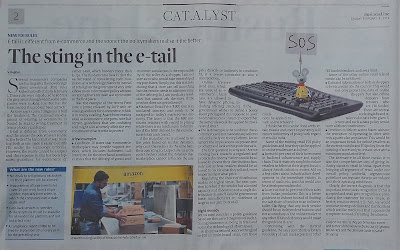
Some points with regard to the dissonance created by guidelines pertaining to online shopping but defined as e-commerce have been explained in this article published in “The Hindu Business Line”. Click on this link to read the article titled, “The sting in the e-tail”.

Business Line, Retail, Indian Retail, Retail FDI, DIPP, V Rajesh Retail

The larger issue which is being conveniently ignored is industry status for the Retail Sector in India. Notifying this would not only help to streamline policy with regard to the various constituents of this sector but also enable the sector to growth.

Will this happen?

Thursday, November 1, 2018

Policy Clarity required to enable Indian Retail

Trade in India is centuries old and historically the stories of our spices, etc., reaching many foreign shores, abound. From a historical perspective, it was these riches that attracted traders from overseas and the subsequent developments led to East India Company establishing a trading base first and then making India into its colony. This historical turn of events might have left a deep and long lasting imprint on the collective psyche which might be manifesting itself in the form of the vigorous and violent opposition to FDI in multi brand retail, today. 

Over the years we have largely seen shop keepers with a few exceptions where businesses managed a chain of stores. It is only from the mid 90s that Retail as a concept emerged in India. Understanding the differentiation between "Shop Keeping" and Retailing is very important. Their approach to business and priorities are completely different. Similarly clubbing eTail (Online Shopping) with eCommerce with regard to policy is incorrect.

As a start, Indian Retail needs Industry status and a cohesive approach with regard to policy-making and governance. My thoughts towards enabling the sector has been published as a Retail Report titled as "Six steps to redefining retail rules" in The Hindu Business Line. (Click on the link to read the article)

Wednesday, October 4, 2017

Price and Value Perception; of products as also businesses!

I recently read an interesting article in Times of India (Click here to read the article) about physical retail offering competitive and lower prices. This is from a report published recently by Goldman Sachs and compares the prices of few categories and some examples are in the visual below. 


My long held view is that online is not going to destroy physical shopping. At the very least, this is not going to happen in the short or even medium term. I have seen concerns similar to this from the mid 90s and more recently in the context of FDI in Retail. When supermarkets and then hypermarkets came into India, everyone was predicting the demise of the local grocer (Kirana store), This has definitely not happened. In fact after almost two decades the modern trade segment is just about 10% of the total Retail sector in India. This is in spite of the fact that the retail sector has grown from approximately USD 200 Billion in 2000 to close to 600 Billion in 2015. This clearly indicates that the conventional outlets are growing and growing significantly. The share of modern trade (Organised Sector) is expected to increase to 13% by 2019 – 2020.

These percentages might vary depending on the report you read. However, the macro picture remains the same. Modern trade is still a small contributor to the overall retail sector in India. This share might drop much lower if food & grocery alone is considered.

Online retail is roughly 10% of modern trade or 1% of the total retail sector in India as of now. This article states that Goldman Sachs estimates that online retail would grow to be 22% of the modern trade in the next five years.

Seems to be extremely optimistic!

The widely varying, but always optimistic projections regarding online retail is best captured a detailed article in Livemint (Click here to read the article).

The variance between the lowest and highest estimate of online retail in 2020 USD 70 Billion. To put that in context, The modern trade contribution to the overall retail sector in India would be in the range of $ 60 Billion TODAY! 

In summary I can only hope that the investors pouring money into the online space do two things –
  • Physical retail is an important segment and investing there might be worthwhile.
  • Put someone to work to cross tally and tabulate all the various percentages and figures being quoted in the various reports about retail in India. The variances across all these forecasts and projections might be a wake-up call.


Image courtesy - Times of India

Wednesday, January 4, 2017

Think like an Omni Channel Retailer

Omni channel retail is being touted as the way forward and the future of retail. Hence the high interest levels as also the aspiration to move in that direction. However the road is not an easy one and there are multiple challenges. While a few are manageable, there are some challenges which would require a paradigm shift in thinking and that is where any such initiative might fail.

The first and foremost challenge is the integrated organizational approach that Omni Channel requires. Offline and online cannot be separate business units with independent deliverables. The challenge to managing this shift lies in being able to balance such an integration while not diluting the accountability and focus on each of these lines of businesses. Take the simple case of credit for sales. In the case of an online order and an offline pick up, who gets the credit for sales? This is important in the context of incentivizing the staff based on sales, which is the norm. 

Similar is the ownership of mistakes and the related costs. If the shopper has picked up products offline and opts for an online based delivery to their home, will the store deliver the purchases or will it go out from a central distribution center. In case of any mistakes with regard to the delivery, who will be responsible and accountable for the same? There are multiple such questions which need to be addressed in the context of Omni Channel and they can be done effectively only if a single unified perspective is adopted.

One possible solution is to adopt a shopper centric model where shoppers from specific geographic areas are assigned to a particular physical store. This could be basis the catchment or trade area defined for that store. Any online activity is treated as a value added service to the shopper and that cost can be apportioned to the respective store. In such a scenario the ownership of sales and other aspects will continue to rest with the store. 

A similar model can be flipped to link a set of shoppers to a designated Sales or Retail manager in the offline operations. In such a case that designated person gets to own the costs and the benefit of sales from that shopper group. They would be similar to a store manager and would operate in a similar manner.

These alternatives are assuming that every shopper opts for Omni Channel purchase which might be a reality in the future but it is not so now. In such a case an interim strategy is required to handle three sets of shoppers; offline, online and Omni Channel.

The biggest challenge would be to manage the shift in the mind set of the front line service staff. Even assuming that the management team buys into the need for change that Omni Channel requires, driving this change in mind set down the line will not be an easy task.

Lifestyle stores can at least adopt a relationship manager model where shoppers get assigned and linked to specific store staff. This would enable a higher level of personalized service as also ownership at an individual level. This would be possible for lifestyle formats because of the relatively lower number of shoppers that frequent such stores. How can such a model be applied for value formats like hypermarkets where thousands of shoppers come in every day and the number of front line staff are also relatively lesser than in lifestyle stores. There does exist a possible solution to this also and the answer might require some unconventional thinking.

However I have saved the biggest challenge for the last which is the temptation to spin off these business segments into separate units for the sake of valuation and funding. Some of the private banks which offered demat and online trading services through their subsidiary were soon tempted to separate this business from banking and also offer online investments on their banking platform. As a customer of such a bank, this has been most frustrating because two relationship managers now pressurize me to do the same thing on two different sites of the same parent bank!

What stops an Omni Channel retailer from spinning off their offline or online business for the sake of valuation and then try to reinvent the wheel by trying to make each of these into Omni Channel again.

The only thing which would deter such a move is a very strong shopper orientation and a constant reminder that the whole Omni Channel evolution is from a shopper perspective and not otherwise.

Thursday, November 17, 2016

No need for change!

Managing adequate change has always been a challenge in retail. Especially when the majority of shoppers tend to pay for purchases, even of the smallest value, with the largest of denominations! I had written about this a few years ago. CLICK HERE to read that article

I can totally empathize with the shop keepers in the context of demonetization and what they must be going through. Suffice to say that they are having a tough time but managing as they always do.

Getting back to the topic of change, it has always been a challenge and my guess is that it will continue to be so even after the supply of the various new notes has become normal. 

The key issue is the habit of carrying larger denomination notes and expecting change during any purchase. In smaller stores they often resort to handing out chocolates in lieu of coins to manage such situations. However, larger stores cannot afford to do this at least as the norm. Needless to say the problem of change does not arise for any credit/ debit card payment. Although technology has enabled digital payments as shown in the video, mass acceptance and use of such payment modes will take some more time to become a common practice.


Increasing use of non-cash payment modes has many benefits and one of the biggest of them all is that retailers need not worry about organizing change. If the current cash crunch ends up influencing the way people pay for their shopping, it would be a good thing.

Video courtesy - Social media forward

Wednesday, October 19, 2016

So, you want to become an Omni Channel Retailer!

The latest buzz word that I am asked about in various forums is Omni Channel and how a retailer can become one. In many cases the understanding of what Omni Channel Retailing is very hazy. In a few cases this is considered to represent a seamless shopper experience across the physical, online and mobile access points of any retailer.

Some of the successful examples of Omni Channel retailing being showcased is more about such a seamless experience. For example, Apple has linked their mobile app to their store and vice versa. The app can be used to book service appointments, order products, etc., and the integration helps the shopper get alerts when they are near a store, receive targeted messages, etc. Carrefour has simplified this by enabling the shoppers to place online orders by voice or scan. Once the order is complete, the same can be delivered or picked up from a store. Several other retailers are experimenting with technology such as electronic tags, Near Field Communication (NFC), etc.

However I feel that all these are more about a superior multi channel approach to retailing. Multi channel retailing is when both online and offline options can be accessed by the shoppers and there is some extent of integration between the two. Omni Channel would ideally be the next step forward where such integration between offline and online access becomes seamless. 

omni channel, online shopping, e tailing, multi channel, bafara, v rajesh retail, shopping, shopper
The key word in this context is - seamless and that cannot be limited to only the information gathering/ sharing or shopper interface. Shopping is after all about purchasing physical products and unless the physical dimension of shopping becomes seamlessly integrated across physical, online and mobile.

Omni channel retail should be defined by the acronym BAFARA. This stands for Buy Anywhere, Fulfill Anywhere and Return/ Replace Anywhere.

Most of the current examples tend to focus on the “BAFA” part whereas this is an incomplete value proposition from a shopper’s perceptive. One point of view is that the extensive analytics and shopper profiling that is done would enable retailers to deliver the exact requirements of any shopper. The logic is that, therefore the need for return or replacement would not exist. Hence the focus on “BAFA” is good enough for creating a Omni Channel offering. 

As someone who understands shopper behavior and expectations I do not think that this would be acceptable to shoppers. Whether they actually return or replace any product purchased or not, they would like to have that option available to them at any given time.

An ideal Omni Channel experience offering BAFARA would play out somewhat like this;

I am leaving office and suddenly remember that I was supposed to purchase a few items as guests are expected at home in the evening. Thankful for having remembered I place an order for these items on the mobile app and select the option for a store pick up. Since I have paid for the same, these are available for immediate pick up and I don’t even have to park my car. I reach home with the purchases only to find that a few products need to be returned. Since I am logged into my home computer, I access my shopping history online and place a request for the return of these products. Since I am travelling the next day, I select the pickup from home option for the return. 

I bought the items on my mobile, picked it up from the store and would be returning it from my home. BAFARA essentially means the convenience of being able to shop in this manner with various permutation and combinations. That would truly be Omni Channel retail.

Sounds simple enough but it is not so and the challenges start mounting if one were to truly deliver the BAFARA value proposition. 

The primary challenge and to some extent becomes a constraint is with regard to the organizational structure and management mindset. In a scenario where offline and online channels are treated as separate business units with independent deliverables as also responsibilities, they become competitors. This is a significant bottleneck in the journey to becoming an Omni Channel retailer.

There are several other strategic as also operational challenges which have constrained most of the Omni Channel initiatives to remain restricted to BAFA instead of offering BAFARA. I shall detail the key challenge with some ideas with regard to the same in another post.

In summary all I would say is that Omni Channel is not about technology and data alone. It is equally about physical products and owning the shopper experience, end to end. This holistic experience cannot be restricted to BAFA and must encompass BAFARA. Till that is clearly and very well defined as also executed, experiments in the Omni Channel space would remain just experiments.

Friday, July 22, 2016

Customer delight is a function of expectations

The Kabali fever is on and I succumbed to it! After watching the movie some interesting perspectives with regard to retail cropped up in my mind. Obviously the power of branding and the ability to drive massive, unheard-of footfalls into theatres is one of the predominant thoughts. The related thought is with regard to converting these walk-ins into repeat customers and loyal shoppers.

That the movie Kabali has had an unprecedented amount of build up and hysteria is an understatement. It was released on 22nd July 2016 across the world in thousands of screens. I don’t think that any other movie has been screened in Chennai city today. All screens are showing Kabali from as early as 4.00 am onwards. Aircrafts were painted with the Kabali picture, hotels had Kabali menu and even some organizations declared a holiday as the majority of the employees were anyways expected to be absent from work. In sum, this extended weekend can safely be called as the Kabali weekend!

Needless to say this hype along with a near total secret shroud around the storyline and other details about the movie helped create an anticipation and expectation which was far more than even sky high. In Rajini terms, it was galaxy high!

I was reminded of several of the store launches we had choreographed where similar hype would be created albeit at a much smaller and localized level.

Now I come to the moment of truth; the movie experience. I am not going to share any spoilers or story details. Let the Kabali weekend play out and maybe I will add on some views regarding this later on. As of now, all ye fans can look forward to the movie without any spoilers from me at least.

The experience I would like to talk about is that of an excited viewer on the first day of a Superstar’s much awaited movie. In a manner of speaking it was the first day, first show as it was the first show in the theatre we went to see Kabali. The usual scenes of super excited crowds were seen outside the theatre. The expected thrill from the movie was writ large on the faces of everyone. As expected there was a person in a suit trying to believe and also make others believe that he was Kabali. Shouting, hooting, jostling, etc., was all adding up and increasing the excitement levels. We were allowed into the theatre and the entry of the audience was punctuated with whistles, shouts etc. The start of the movie was amazing where the audience thrill, enthusiasm and excitement were as interesting to watch if not more.

The first few scenes where Thalaivar Rajinikanth makes his entry, delivers some of his key dialogues, etc., and was greeted wildly by the audience with whistles, people standing up, clapping and more. Subsequently, the theater settled down and everyone watched the movie in silence. Barring a few moments of euphoric whistling, clapping and cheers, the three hours was by and large a quiet experience. Even the ending seemed to be subdued as everyone made their way out of the theatre.
This is not what one usually experiences in a first day first show of a superstar. In fact many people go to these shows to see the fans in action and be a part of the excitement. They then go to actually watch the movie again.

I am not going to comment on whether the movie was good or bad, speculate about the story, etc. My interest is more in the crowd or customer reaction which I think was markedly subdued. I wonder how many of them would be coming back to watch the movie again and that is what triggered a thought in the context of retail.

Is it that the hype ended up creating expectations which are almost impossible to meet? In such a scenario, initial response might be fantastic but repeat business might be difficult to get. In any retail context hype and excitement is what pulls shoppers to come into any store. The question that any retailer must answer is whether the store can live up to the hype and resultant expectations. The store by itself might be excellent just like how the Superstar’s performance in Kabali is outstanding. However even that might not be enough if the expectations created are way more than what is being delivered. 

One must always keep in mind that customer satisfaction and customer delight is more dependent on the expectations being created than the actual delivery and experience.

Picture courtesy - V Creations

Thursday, June 16, 2016

Are you ready to change the way you shop!

I have been writing about the disruption in the way people shop for some time now. Technology like Google Glass, HoloLens, 3D Printing, etc., is going to disrupt the retail environment as much as the internet did or maybe more so. It is only a matter of time before such devices become mainstream because of their price becoming affordable as also supporting software being available. Slowly but surely these changes are entering into the retail environment.
 
One of the key shopper expectations is to be able to purchase products which are different, unique and customized. Such purchases used to be quite expensive but no longer. Shoppers can now purchase 3D printed and customized products online from sites such as Shapeways, i.materialise, thingify, etc. Amazon has taken this to the next level and plans include a patented 3D printing truck which would come to your doorstep and print out the product! When 3D printers become affordable and mainstream, you could do the same at home, without even having to wait for that truck.

Alternatively you could drop into a store and get things made for you in a short while. This could be anything including a book being printed and bound in front of your eyes. This is what “Librairie des Puf”, a book store run by the publisher University Press of France does. They use an Espresso Book Machine which makes a book right in front of your eyes.


This machine used to be quite expensive but the prices have dropped over the years. Many smaller stores tried adopting a similar model but ran into issues when the publishers were not ready to share the content for instant printing of the books. Although eBooks are gaining ground, there are a significant number of readers who still prefer a hard copy one to read. With real estate costs rising and the overall spends on physical books becoming very niche, this trend of buying instantly printed books might be the future for the purchase of books.

As a shopper if you like online, the next level would be the virtual world and retail might cater to that preference too. Shopping in a holographic, 3D virtual store might take a bit longer but a step closer to this is what eBay is trying out in Australia. In association with Myers, a leading department store chain they are bring Virtual Reality stores to the shoppers, wherever they might be in the country.

This video would give you an idea of how the Virtual Reality shopping will be done in what is positioned as the world’s first Virtual Reality Department store.

An earlier post had detailed about how shopping might evolve in the coming years. The pace at which technology is evolving shows that the future is far closer than what was thought. Physical shopping, Online, Omni channel and it seems like it virtual reality shopping will soon encompass all these while redefining the retail space, business models, etc.

Are you ready to change the way you shop! 

Thursday, April 28, 2016

Do organisations really want Happy Customers?!

I saw a cartoon in a leading national daily and was struck by the irony in this illustration. Although it is prima facie humorous, it is also a reflection of the reality and holds a very strong message to organizations, especially Retailers.

customer delight, customer service, service, retail, etail, online shopping, service delivery

It raises the following questions which I will address.
  • Do Retailers expect any customer to be happy, satisfied or delighted at all?
  • Are organizations serious about making customers happy, satisfied or delighted?
  • If there is no breed called happy customers, whose fault is it?


Forget Retailers, most organizations do not expect their customers to be even satisfied forget about being delighted. The rationale behind this statement is the fact that I am yet to come across anyone having a system or process to handle happy or satisfied customers. Let me illustrate this with an example from two service sectors. In most stores there are loyal customers who are happy and often give positive feedback and express their satisfaction with the store and staff members. Unfortunately these customers are often ignored while unhappy customers who complain get a lot of attention. In most of my programs I have advocated customer interaction forums where such loyal and happy customers are invited and that recognition alone would be a first level of reward for these shoppers. The second example is with regard to a leading airline. I had praised the way their staff had handled a situation and had messaged them. Imagine my surprise when I got a template reply thanking me for my patronage and feedback. Obviously their service staff has no idea about handling a happy customer.

Of course, it can be argued that organizations expect all their customers to be happy and that unhappy customers need to be handled as they are the exception. This is totally wrong. Even if satisfied customers are the norm they need to be recognized in order to motivate them to continue sharing this satisfaction and happiness.  Apart from reproducing a few appreciative letters or comments, most organizations do not even acknowledge satisfied customers.

This situation is largely because most organizations espouse customer service and delight while their actions on the ground are directly opposite to that. A very common example is the promise of a hassle free replacement while making the actual process for this painful enough to dissuade the shopper. Every shopper of physical or online retail must have experienced the sheer frustration of trying to resolve an issue wherein the customer service person responds like a robot with template responses which in most cases are completely irrelevant. In the case of such a reality it is highly questionable if organizations especially retailers are really serious about customer satisfaction or are they focused only on managing dissatisfied customers.

This is again a problem with regard to the service delivery design and the management’s orientation towards customers and shoppers. Although the stated intent of the organization is great service and satisfied customers, almost every system and process in place focuses on controlling and constraining the front line staff. This means that they are rarely empowered to deliver customer satisfaction. Obviously such staff have no clue about handling happy customers simply because they are not empowered to make the customer or shopper happy!

Lastly is the point about whose fault is it. Although organizations are at fault, the customer and shoppers must share some of the blame with regard to this situation. The majority of shoppers are eager to complain and make a noise when they are not satisfied. Unfortunately they rarely take the trouble to even mention situations and interactions which make them satisfied or happy.

The old saying that “the squeaky wheel gets the grease” is very apt in this context. Unhappy and dissatisfied customers make a noise and so organizations take the trouble to think of ways to handle them and manage such people. Happy and satisfied customers keep quiet and so the organization in most cases is not even aware that they exist. It is no wonder that most staff members do not know how to handle happy customers and their appreciation.

This cartoon is actually a reflection of reality and for this to change the customers and shoppers need to speak up when they are happy and satisfied. Organizations on their part should start recognizing happy customers instead of only managing the unhappy ones. 

Cartoon courtesy - The Hindu

Monday, April 4, 2016

Replacement Guaranteed!

The recent spate of messaging by the online Retail majors hinges on reassuring the shopper that it is very easy to return or replace what has been purchased.

This is a core shopper expectation which is catered to very efficiently by the stand-alone, neighborhood store.  Interestingly modern retail formats including eTailers  are still struggling to establish trust on this front.  This is a very critical shopper behavior aspect and some of my earlier posts on this topic can be viewed by Clicking HERE

v rajesh, retail expert, shopper behaviour, marketing, customer service

I had a flashback to the late 90s, when the RPG Foodworld chain of supermarkets was trying to redefine the grocery and food shopping behavior. This involved addressing several key mind blocks and shopper resistance aspects; hassle free replacement being one of the most important amongst them.

“Replacement Guarantee” was an initiative to address this important issue and it involved a holistic approach which included messaging, internal processes as well as staff education and training. This had a very positive impact which was reflected in the sales increase as also the basket penetration of several core categories of products.

Coming to the present times the two recent advertisements by Amazon and Flipkart are focusing on the ease of return and replacement. These two advertisements drive home the message effectively.


It is interesting to note some subtle and sublimal messaging in both these advertisements and they do raise two important questions in my mind as a retailer.
  1. Both the advertisements show an elderly person expressing concern about return and replacement. They are both reassured by someone who is much younger. Is easy return/ replacement a concern only for Gen X / older shoppers? The counter point could be that this a concern for the Gen Y and Gen Z but the advertisement is trying to drive home a message that their Gen Y and Gen Z customers do not face this problem. In that context are reference groups such a large influence for these shoppers?
  2. Retail brand building is built on trust which can happen only during the transactional experience.  Even today, the return/ replacement in most modern formats and eTailers are definitely not up to the mark. In that context will messaging alone work? What process changes have these eTailers instituted to ensure that the real experience lives up to the expectations created through the advertisements?

Thursday, December 10, 2015

Future of Retail; Bringing the store to you

Google Glasses coupled with 3D printing opened up a whole new dimension of shopping. I had written about this and a blue sky idea was that people might move away from purchasing products to buying 3D print designs and make their own products at home. This is very much a possibility in the future when the materials and composites required for various kinds of 3D printed products as also 3D printers become main stream and a part of most homes.

In the meantime there is another interesting technology which might merge the physical and online retail worlds to give you the best of both.

Shoppers opt for eTailing because of price, convenience and range. The competitive advantage of convenience is coupled by the fact that online retail is not constrained by physical store size. This enables them to offer a far wider and deeper range, called as a long tail of merchandise.

Shoppers also take the trouble of going to physical stores in order to browse and have a shopping experience which consists of “Touch, Feel and See”.

Imagine a scenario where you want to shop for a new dress and you sit back in your recliner and the store actually comes to you and enables you to shop. Is that not a fantastic combination of physical and online retail? 

Is that possible?

There are emerging technologies which enable visualization which has led to innovations like virtual dressing rooms. However, a new technology when coupled with visualization might actually bring the shop to you in the near future.

Microsoft has been working on a technology called HoloLens. 

Very simply put, this creates a 3 dimensional holographic view for the viewer and they can interact with the same. This video would give you a better idea about HoloLens.


How is this relevant and applicable to retail?

Retailers can leverage this platform to create 3 dimensional stores which can be accessed by the shopper in the comfort of their home. Creating such 3D stores is already possible and being used for a different purpose. Today there are several IT solutions that create a 3 dimensional rendering of the store and make is quite realistic. See the first video to get an idea about how 3D store would look like and the second video to see how Carrefour has used Google Street View to create a virtual shopping experience using kiosks and hand held devices. 


The logical next step would be to project this as a 3D immersive hologram in the coming years.

Combine these technologies and it would be possible to bring home the store. Add on technologies which are being worked on like delivering sensory influences such as smell and a feel of touch. Voila, your store will be as real as it can be and more importantly, exclusive to you.

In such a scenario, if you want to buy a new dress you might sit back and slip on your HoloLens device or some other similar device and the store comes alive before you. You can browse, use visualization to try on dresses, check out accessories, compare prices and much more.

As compared to printing products at home, bringing the store home seems much closer to reality. This is all the more pertinent in the current context where both physical and online retailers realize the need to be present on both platforms. A giant like Amazon has opened physical stores and several physicals stores are in the online space.

Bringing a store home is now possible and a retailer who gets their act together to make this happen might establish a strong competitive advantage, especially in India.

Monday, September 28, 2015

The way men and women shop

There are countless jibes that are directed at women about shopping and their fondness for the same. However, it is a reality which is not well known that there are validated reasons for the differences in shopping behavior between men and women.

This cartoon of Calvin & Hobbes is an interesting depiction of how men get confounded by choice which would not be the case if a woman were shopping.


There are two fundamental differences between men and women which defines their orientation towards shopping and why they differ from each other.

Women are supposedly much better at multi tasking and anyone who has taken a ride with their mother would know that it would be a fun ride where the woman would not mind having loud music being played while she chats and also drives. This would be a direct contrast to a ride with a male who would prefer minimal distractions when driving and absolute quiet might be a de-facto requirement when navigating heavy traffic.

Women are supposed to have a wider peripheral vision. This essentially means that women can take in more visual stimuli as compared to men. Men have a stronger straight-on vision supposedly a hangover from the hunter-gatherer days. This means that men prefer a single target to zoom into and complete the task.

This obviously has significant implications for any retailer. The store and all the various elements inside in terms of design, display, etc has to be different, depending on whether the focus of that store is on women shoppers or men.

As the cartoon shows, men shoppers should ideally be presented with a simple design, easy to choose display and a quick shopping experience. The direct opposite is required if a retailer is targeting women shoppers.

That is not all, even the service and interaction levels would have to be tailored and structured differently for men and women as women are more socially inclined and actually welcome interactions. On the other hand, men are far more functional and their expectations are for functional service.

Cartoon courtesy - The Hindu Metroplus

Tuesday, August 18, 2015

Who is shopping for what and when?

It is becoming common place to see mega sales and promotions being advertised and promoted by online retailers in India. However, what puzzles me is their timing. Most of these promotions are scheduled to start on Mondays and are during weekdays barring a few exceptions. This is in direct contrast to the physical stores. The brick and mortar stores usually gear up for promotions during the weekends namely Friday, Saturday and Sunday. They stock up, plan for adequate manpower and hope for the bumper weekend sale.


The weekend phenomenon is clearly a function of time where shoppers are free. Also, with shopping becoming more of a recreational cum functional outing, this tends to happen on weekends. Obviously online shopping is not time intensive and that is one of its main advantages. However, the timing of holding such promotional sales during weekdays, especially with a start on Monday’s is something worth exploring with regard to who buys from such sales, what is purchased and why on weekdays.

Conventional wisdom says that Monday would be amongst the busiest days for most working people and sparing time to even browse and click might not be possible for most. As clear data with regard to the age of online shoppers is not available easily, the next best reference is the age of internet users. A February 2015 report by PWC estimates that 37% of the users are in the age group of 15 – 24 and 38% are in the 25 – 34 years age group. It is quite possible that the majority of them are students or are in the early stage of their careers. They are also the Gen X whose orientation towards work as also work-life balance is very different from the older generations. Hence a weekday pressure, especially Monday pressure is not such a big factor.

This is validated by the categories that dominate online shopping in India. Another report by by RedSeer consulting dated March 2015 shows that 45% to 50% of online purchases are electronics and this could very well be dominated by mobile phones. Next is fashion with a share of 18% to 20%. Clearly these categories have a correlation with the dominant age groups of internet users and validate the weekday promotions of online retailers versus the weekend focus of physical stores.

In spite of increasing smart phone usage and shopping apps, 2/3rd of the orders are coming from a computer and only 1/3rd is originating from a smart phone. Many organizations especially those employing large numbers of the Gen X do not allow free access to online shopping and social network sites. If the majority of the potential online shoppers do not have access to these sites at work on their computer, they should be purchasing through their mobile. In which case the share of orders from mobiles does not reflect this and should be higher.

So the question remains, who is buying when and what online in India.